


研究成果

Title: A flexible arched artificial photoreceptor constructed by photodeformable liquid crystal polymers and its application in vision restoration
Author: Yumeng Jiang, Bo Peng, Jinyu Ma, Feng Pan, Jia Wei, Lang Qin, Cheng Sun, Yanlei Yu*
Journal: Smart Mol. 2026, e70030.
Abstract:
Artificial photoreceptors capable of eliciting neural responses offer a promising strategy for restoring vision in individuals with retinal degenerative diseases. However, stimulating neurons under low-intensity light remains a critical challenge, which significantly hampers their practical application. Here, a flexible arched artificial photoreceptor with strong photoelectric response under weak light is constructed by photodeformable liquid crystal polymers (LCPs) and polyvinylidene fluoride-trifluoroethylene (P(VDF-TrFE)). The light-stress-electricity conversion arising from photo-induced stress of LCPs and the piezoelectric effect of P(VDF-TrFE) is significantly enhanced by the arched structure, which induces stress concentration. Hence, the open-circuit voltage reaches up to 17.51 ± 0.60 V under 8 mW cm−2 light irradiation, which is 21 times higher than that of the planar structure (0.79 V), with a 10-fold reduction in light intensity. By analyzing the voltage of units, the pixelated matrix of artificial photoreceptors is capable of imitating complex visual functions including light detection, pattern recognition and information decoding. Notably, the flexibility and biocompatibility endow this artificial photoreceptor with great potential in artificial retinal applications. Blind rats implanted with this artificial photoreceptor are demonstrated to exhibit restored visual responses. This study presents a novel approach to fabricating artificial photoreceptors which are sensitive to weak light and provides new insights for the applications of LCPs in implantable devices.
论文链接:http://doi.org/10.1002/smo2.70030
PDF下载: A flexible arched artificial photoreceptor constructed by photodeformable liquid crystal polymers and its application in vision restoration
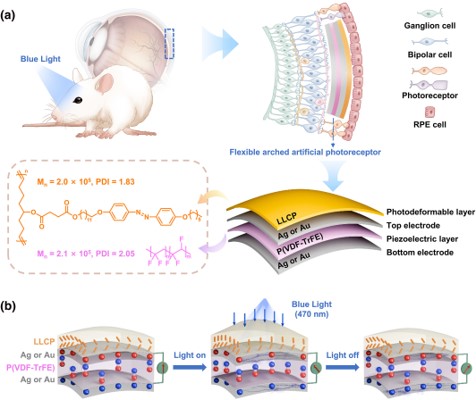
光感受器通过感光色素将光学信号转化为神经电刺激,在视觉传导过程中至关重要。视网膜退行性疾病(如视网膜色素变性或老年性黄斑变性)的患者因光感受器受损或丧失导致严重视力障碍或失明。已有研究证实,采用视网膜下假体的生物工程视觉系统可以有效刺激神经元并诱发视觉反应,但是这类系统需要复杂的布线并涉及繁琐的外科手术。因此,该领域的近期研究聚焦于具有光电转换功能的智能材料,以构建能替代受损天然光感受器的人工光感受器。然而,常见的无机光电材料与柔软神经组织模量不匹配,而有机光电材料则因光电化学反应产生的光激发电子可能存在生物毒性。此外,光热-热释电复合材料虽表现出较强的光电响应,却有对组织造成热损伤的风险。
本研究报道了一种由光致形变线型液晶高分子(LLCP)、压电材料P(VDF-TrFE)与电极复合构筑的柔性拱形人工光感受器。LLCP的结构中含有柔性主链与偶氮苯基团,由于液晶分子间协同效应和长间隔提供的自由体积,可以自组装形成高度有序的相结构。在470 nm光照下,偶氮苯基团发生反式-顺式-反式的异构化循环,导致自由体积膨胀并产生光致应力。当应力传递至P(VDF-TrFE)层后,层中偶极密度的变化导致电极中的电荷重新分布,因此可以检测到电信号输出。通过调控拱形结构的曲率半径并研究器件的应力集中效应,有效增强了光-应力-电转换,使器件可以在8 mW cm-2弱光照射下输出17.51 V的电信号。与之前报道的同体系研究相比,开路电压提高了21倍,而光照强度降低了10倍。将多个人工光感受器集成为像素化矩阵可以模拟天然光感受器,实现光源方向识别、光强度识别、复杂图案识别与信息解码等复杂视觉功能。最重要的是,该人工光感受器兼具优异的柔韧性、稳定性与生物相容性,是作为植入式视网膜假体的理想候选材料。将人工光感受器植入盲鼠眼底后,电生理检测和动物行为学分析表明盲鼠在术后恢复了视觉响应。本研究为开发弱光响应的植入式人工感光器开辟了新途径,并为液晶高分子材料在植入式器件中的应用提供了新思路。
电话:021-31243661
传真:021-31243661
邮编:200438
地址:上海市杨浦区淞沪路2005号,复旦大学智能材料与未来能源创新学院(先进材料楼725)
网址:http://lcpolymergroup.fudan.edu.cn
电子邮件:ylyu@fudan.edu.cn