


研究成果

Title: Co-optimizing photodeformation and stiffness in azobenzene polyimides for enhanced photoinduced stress and multimodal sensing
Author: Xingpeng Chai, Menghan Zhang, Dandan Xu, Zehao Wang, Jia Wei*, Yanlei Yu*
Journal: Mater. Horiz. 2026
Abstract:
Photomechanical-to-electrical conversion offers an alternative pathway for optical sensing, but reliable and highly linear signal requires large and reproducible photoinduced stress. Achieving such mechanical output remains challenging because efficient photodeformation and a high elastic modulus are often difficult to reconcile through molecular design. Herein, the backbone architecture of azobenzene polyimides (azoPIs) was systematically engineered by varying the dianhydride structure while maintaining identical azobenzene content and flexible-segment fraction. Among the resulting polymers, the 6FDA-based azoPI (azoPI-6FDA) exhibits the most favorable combination of mechanical stiffness and photodeformation (E=3.27 GPa and a bending angle of 75° under UV irradiation), and possesses a high photoinduced stress of 2.0 MPa. AzoPI-6FDA was subsequently integrated with PVDF-TrFE to construct flexible photomechanical-to-electrical sensing devices in both laminated and coaxial fiber configurations. In the laminated device, photoinduced stress generated by azoPI-6FDA was transferred to PVDF-TrFE and converted into a piezoelectric voltage of up to 9.0 V. Both the photoinduced stress and electrical output exhibited nearly linear dependences on UV intensity, with correlation coefficients approaching 0.99, enabling quantitative optical sensing. The coaxial electrospun membrane combined stable electrical output with an elongation at break exceeding 200% and maintained reliable sensing performance under bending. Moreover, UV irradiation generated dominantly unipolar voltage signals, whereas mechanical loading and unloading produced characteristic bipolar piezoelectric signals, allowing direct discrimination between optical and mechanical stimuli without additional signal processing. This work connects molecular backbone design with photoinduced stress generation and device-level signal transduction, providing a robust materials strategy for flexible, self-powered multimodal sensing.
PDF下载: Co-optimizing photodeformation and stiffness in azobenzene polyimides for enhanced photoinduced stress and multimodal sensing.pdf
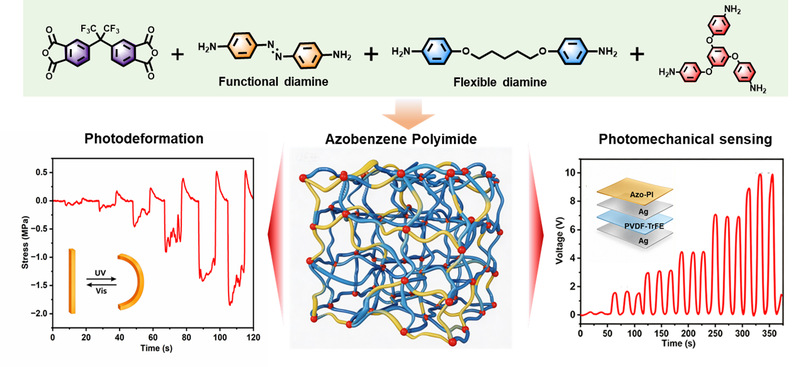
光响应聚合物能够将光刺激转化为机械形变,在柔性驱动、智能传感和仿生等领域具有广阔的应用前景。通过将光响应材料与压电材料相结合,可进一步实现光信号向电信号的转换,为柔性传感器的开发提供了新思路。然而,现有光响应聚合物大多通过引入柔性链段来提高分子链的运动能力,以获得较大的光致形变,但这通常会降低材料的刚度,导致光致应力输出不足。相比之下,聚酰亚胺虽然具有较高的刚度和良好的热稳定性,但其刚性分子结构又会限制偶氮苯的光致异构化及宏观形变。因此,如何兼顾材料的光致形变能力与机械刚度,实现较大的光致应力输出,仍是制约光响应材料在柔性传感领域应用的关键问题。
本文提出了一种通过分子主链结构协同调控光致形变与刚度的设计策略,采用三元共聚策略,制备了四种具有不同主链结构的偶氮苯聚酰亚胺(azoPIs)。其中,azoPI-6FDA的刚性芳香骨架保持较高的机械刚度,同时通过含氟基团增大分子链间的自由体积,促进偶氮苯的光致异构化,从而兼顾较大的光致形变与较高的模量,实现了75°的光致弯曲角度和高达2.0 MPa的光致应力。在此基础上,将azoPI-6FDA与压电聚合物PVDF-TrFE相结合,分别构建了层状复合器件和同轴核壳纤维膜,实现了光致应力向电信号的高效转换。其中,层状器件的最高输出电压可达9.0 V,且输出电压与光照强度呈良好的线性关系;同轴纤维膜的断裂伸长率超过200%,经过1000次光照循环后仍能保持约98%的初始电压输出。此外,利用光刺激和机械刺激产生的不同电信号特征,无需额外的信号处理即可实现对两种刺激的有效区分。该研究为兼具高光致应力输出和多模态感知能力的光响应材料提供了新的设计思路,也为柔性传感器的开发提供了参考。
电话:021-31243661
传真:021-31243661
邮编:200438
地址:上海市杨浦区淞沪路2005号,复旦大学智能材料与未来能源创新学院(先进材料楼725)
网址:http://lcpolymergroup.fudan.edu.cn
电子邮件:ylyu@fudan.edu.cn