Search
Close X





Title: A flexible arched artificial photoreceptor constructed by photodeformable liquid crystal polymers and its application in vision restoration
Author: Yumeng Jiang, Bo Peng, Jinyu Ma, Feng Pan, Jia Wei, Lang Qin, Cheng Sun, Yanlei Yu*
Journal: Smart Mol. 2026, 4, e70030.
Abstract:
Artificial photoreceptors capable of eliciting neural responses offer a promising strategy for restoring vision in individuals with retinal degenerative diseases. However, stimulating neurons under low-intensity light remains a critical challenge, which significantly hampers their practical application. Here, a flexible arched artificial photoreceptor with strong photoelectric response under weak light is constructed by photodeformable liquid crystal polymers (LCPs) and polyvinylidene fluoride-trifluoroethylene (P(VDF-TrFE)). The light-stress-electricity conversion arising from photo-induced stress of LCPs and the piezoelectric effect of P(VDF-TrFE) is significantly enhanced by the arched structure, which induces stress concentration. Hence, the open-circuit voltage reaches up to 17.51 ± 0.60 V under 8 mW cm−2 light irradiation, which is 21 times higher than that of the planar structure (0.79 V), with a 10-fold reduction in light intensity. By analyzing the voltage of units, the pixelated matrix of artificial photoreceptors is capable of imitating complex visual functions including light detection, pattern recognition and information decoding. Notably, the flexibility and biocompatibility endow this artificial photoreceptor with great potential in artificial retinal applications. Blind rats implanted with this artificial photoreceptor are demonstrated to exhibit restored visual responses. This study presents a novel approach to fabricating artificial photoreceptors which are sensitive to weak light and provides new insights for the applications of LCPs in implantable devices.
Link:http://doi.org/10.1002/smo2.70030
PDF: A flexible arched artificial photoreceptor constructed by photodeformable liquid crystal polymers and its application in vision restoration
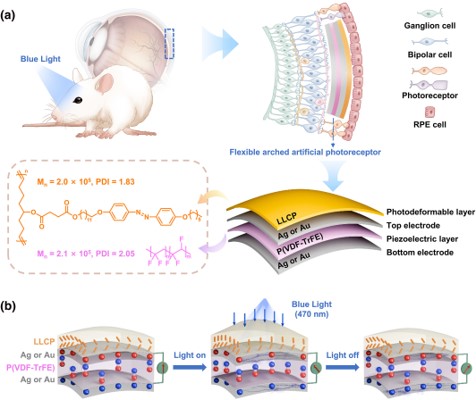
Photoreceptors convert optical signals into neural electrical stimuli via photopigments, playing a crucial role in visual signal transduction. Patients with retinal degenerative diseases, such as retinitis pigmentosa or age-related macular degeneration, suffer from severe visual impairment or blindness due to damage or loss of photoreceptors. Previous studies have demonstrated that bioengineered visual systems based on subretinal prostheses can effectively stimulate neurons and evoke visual responses; however, such systems require complex wiring and involve intricate surgical procedures. Therefore, recent research in this field has focused on smart materials with photoelectric conversion capabilities to construct artificial photoreceptors that can replace damaged natural photoreceptors. However, common inorganic photoelectric materials suffer from modulus mismatch with soft neural tissues, whereas organic photoelectric materials may pose biotoxicity risks due to photoexcited electrons generated by photoelectrochemical reactions. In addition, photothermal-pyroelectric composite materials, despite their strong photoelectric response, carry the risk of thermal damage to tissues.
This study reports a flexible arch-shaped artificial photoreceptor constructed by combining a photo-deformable linear liquid crystal polymer (LLCP), the piezoelectric material P(VDF-TrFE), and electrodes. The LLCP contains a flexible backbone and azobenzene groups; owing to the cooperative effects among liquid crystal molecules and the free volume provided by the long spacer, it can self-assemble into a highly ordered phase structure. Under 470 nm light irradiation, the azobenzene groups undergo trans–cis–trans isomerization cycles, leading to free volume expansion and the generation of photostress. When the stress is transferred to the P(VDF-TrFE) layer, the change in dipole density within the layer induces charge redistribution in the electrodes, thus enabling the detection of electrical signal output. By tuning the curvature radius of the arch structure and investigating the stress concentration effect, the light-to-stress-to-electricity conversion was effectively enhanced, enabling the device to output an electrical signal of 17.51 V under weak light irradiation of 8 mW cm⁻². Compared with previously reported studies on the same material system, the open-circuit voltage was increased by 21 times, while the light intensity was reduced by 10 times. Integrating multiple artificial photoreceptors into a pixelated matrix can mimic natural photoreceptors, enabling complex visual functions such as light source direction recognition, light intensity discrimination, complex pattern recognition, and information decoding. Most importantly, the artificial photoreceptor combines excellent flexibility, stability, and biocompatibility, making it an ideal candidate material for implantable retinal prostheses. After implanting the artificial photoreceptor into the fundus of blind mice, electrophysiological recordings and behavioral analyses demonstrated that the blind mice recovered visual responses post-surgery. This study opens up a new avenue for developing weak-light-responsive implantable artificial photoreceptors and provides new insights into the application of liquid crystal polymer materials in implantable devices.
Phone:021-31243661
Fax:021-31243661
Postal Code:200438
Address:College of Smart Materials and Future Energy (Room 725, Advanced Materials Building), Fudan University, 2005 Songhu Road, Yangpu District, Shanghai
URL:http://lcpolymergroup.fudan.edu.cn
E-mail:ylyu@fudan.edu.cn