Search
Close X





Good News | Professor Yu Yanlei’s Team Awarded the Second Class of the National Natural Science Award
Time:2026-07-21
Views:10
The National Natural Science Award is a national-level scientific award established by the State Council of China, and is one of the most authoritative and prestigious honors in the fields of basic research and applied basic research. The award has two grades: First Class and Second Class. The Second Class is conferred on original achievements that have made important scientific progress, reached internationally advanced academic levels, and have been widely recognized and cited by the domestic and international academic communities. The project Creation and Regulation Mechanisms of Light-Controlled Liquid Crystal Polymer Actuators was accomplished by the team of Professor Yu Yanlei from the School of Intelligent Materials and Future Energy Innovation at Fudan University, after more than ten years of dedicated research. Starting from molecular-level innovation, the team covalently integrated photoswitchable molecules with liquid crystal mesogens, utilized the cooperative effect of liquid crystals to amplify molecular-scale responses, bridged the gap between microstructural changes and macroscopic actuation, created novel smart materials with actuation performance surpassing that of biological skeletal muscle, and developed all-optical microfluidic devices that enable contactless precise manipulation and efficient transport of liquids, providing entirely new solutions for soft robotics and intelligent medical diagnostics. This project was honored with the Second Class of the 2025 National Natural Science Award.
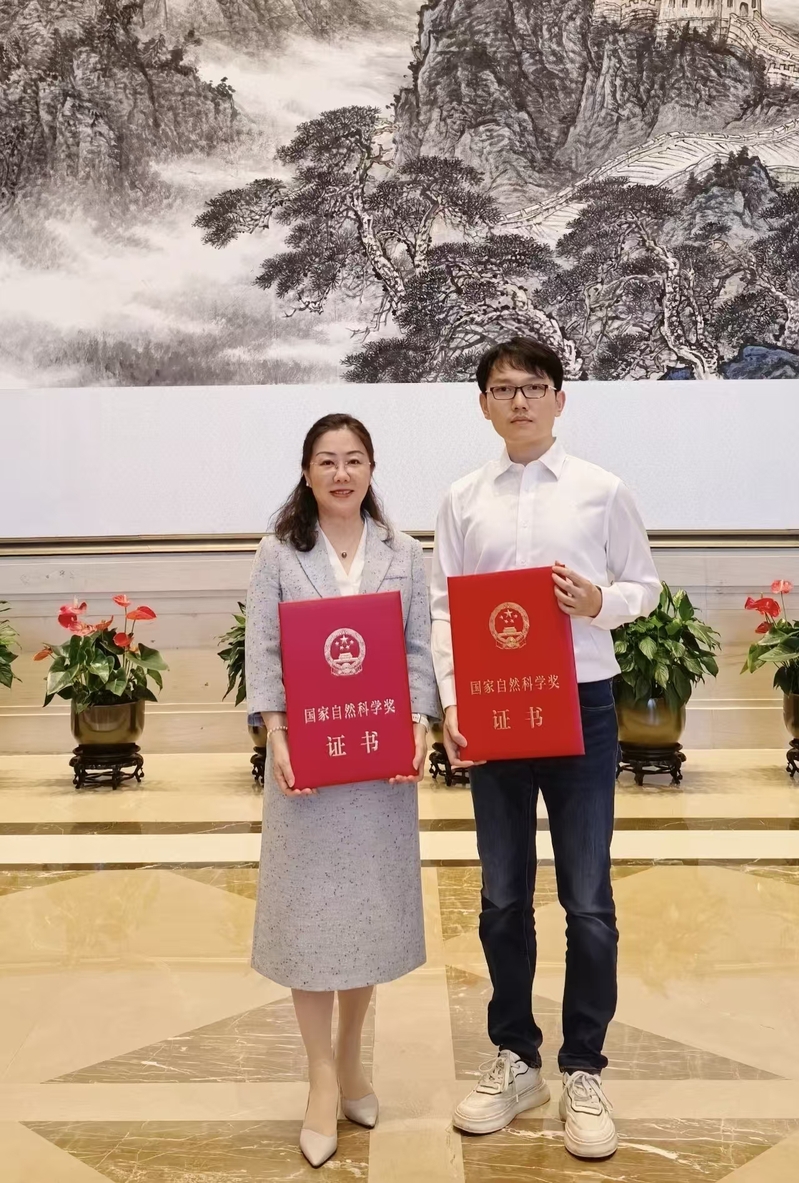
Professor Yu Yanlei and Associate Professor Qin Lang at the award ceremony
Smart materials that move with light
In nature, an octopus tentacle is as soft as silk yet can instantly tighten for precise grasping—such actuation capability represents a long-standing goal for scientists: to create intelligent soft materials that combine the flexibility and processability of polymers with the sharp responsiveness of liquid crystals to external stimuli such as light and heat, enabling rapid reversible responses and precise control. Professor Yu Yanlei's team pioneered a molecular design concept by introducing rigid liquid crystal mesogens into photoresponsive polymers, covalently bonding photoswitchable molecules with mesogens, and exploiting the cooperative effect of mesogens—like a well-ordered queue—to amplify molecular-level changes stepwise into macroscopic deformation and force output, establishing a multiscale structural change mechanism from molecules to materials. Conventional photoresponsive polymers suffered from random chain arrangements, where the structural changes of photoresponsive molecules interfered with and canceled each other out, resulting in only weak macroscopic deformation and negligible force output. This innovative design broke through that bottleneck, increasing deformation amplitude by 100 times, and was the first to achieve long-wavelength, low-energy light-driven actuation, moving photoresponsive actuator materials from concept to reality.
The team further developed novel preparation methods for long-range-ordered liquid crystal polymer actuators using olefin ring-opening metathesis polymerization, producing materials with well-defined chain structures and micrometer-scale ordered alignment. This approach overcame the trade-off between deformation ratio and elastic modulus, achieving a photoinduced contraction of 81% and a photogenerated stress of 2.2 MPa—actuation performance surpassing skeletal muscle, toughness comparable to natural rubber, and a modulus tunable across three orders of magnitude. Much like versatile building blocks that combine rigidity with flexibility, these new materials can be seamlessly integrated with plastics, rubbers, and other materials to construct complex three-dimensional devices such as light-controlled peristaltic pumps and adaptive crawling soft robots.
Based on the unique photomechanical deformation characteristics of this material, the team discovered that liquid crystal polymer channels undergo axial asymmetric deformation under light irradiation, which drives fluid flow. They proposed a new mechanism of programmable light-induced dynamic Laplace pressure gradients for liquid transport and vortex mixing, replacing traditional external mechanical pumps in microfluidics with contactless optical control, achieving efficient transport and mixing of microfluids. The team accordingly created the first all-optical microfluidic chip and a point-of-care protein detection device, capable of highly sensitive and rapid quantification of heart failure biomarkers using only 600 nanoliters of sample within 5 minutes.
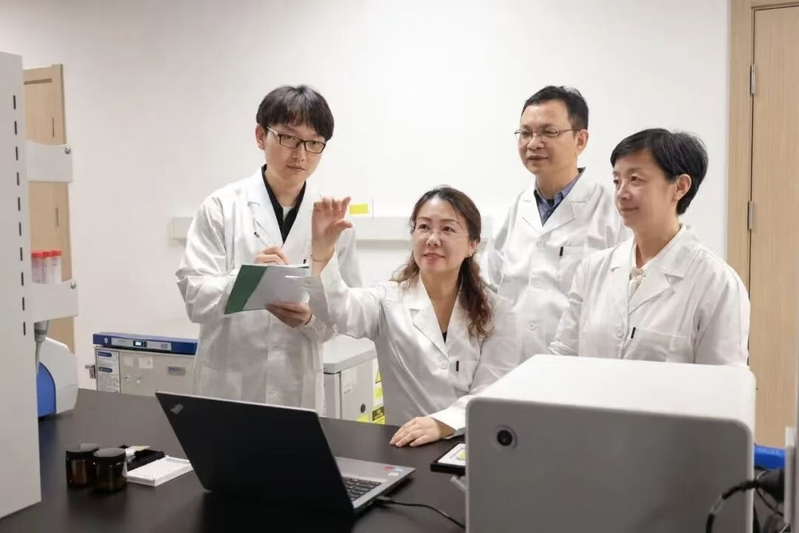
Professor Yu Yanlei's team discussing research work
Igniting a wave of cutting-edge research
In conventional photoresponsive polymer networks, individual photoswitchable molecules move independently—their microscopic changes interfere with and offset one another, resulting in virtually no macroscopic deformation and no force output. The team discovered that by aligning these molecules in a well-ordered formation via the cooperative effect of liquid crystal mesogens, molecular-scale changes could be amplified stepwise into macroscopic deformation and force generation—making the material truly move and deliver work. On this basis, they further tackled the longstanding trade-off between deformation capacity and mechanical strength, creating materials that are as powerful as skeletal muscle, as tough as natural rubber, and compatible with plastics, rubbers, and other materials for constructing complex actuating devices such as peristaltic pumps and crawling robots. Most notably, the team used this new material to fabricate the world's first all-optical microfluidic chip, replacing conventional mechanical pumps with light fields for contactless, precise manipulation of minute liquid volumes.
The six representative papers of this project were published in journals including Nature and Advanced Materials, receiving a total of 1,560 SCI citations (excluding self-citations). They have been cited and followed by over 30 academicians and research groups from 54 countries/regions, including Nobel laureate Professor Ben L. Feringa, and have been hailed as a new generation of high-performance liquid crystal polymer photomechanical materials and a truly pioneering achievement of landmark significance.
From follower to leader—twice in Nature
Throughout this scientific journey, Professor Yu Yanlei has published twice in Nature, yet with profoundly different sentiments. During her government-sponsored overseas study in Japan, she devoted herself to photomechanical research on liquid crystal materials. After countless sleepless nights in the laboratory, she published as first author in Nature in 2003. This work attracted worldwide attention, with laboratories from several countries inviting her for postdoctoral research, while domestic institutions also took note, hoping she would return to China to continue her academic career. Professor Yu Yanlei returned to Fudan University immediately after obtaining her doctorate and, starting from scratch, led her team with the courage to venture into uncharted territory, deeply cultivating the field of photoresponsive liquid crystal polymers. Because that 2003 Nature paper was affiliated solely with Tokyo Institute of Technology, this detail became a lingering regret for her. She resolved to nurture even better innovations on China's own research soil. After more than a decade of technical efforts, in 2016, Professor Yu Yanlei, as sole corresponding author with Fudan University as the sole affiliated institution, published again in Nature. This entirely Chinese-originated work was reported by mainstream media including CCTV News Broadcast, Morning News, and The Economist (UK), and was listed among Shanghai's Top 10 Scientific Events of 2016. These two Nature papers, separated by thirteen years, not only chart a scientist's ascent to the pinnacle of research but also reflect China's broader transition from following international trends to leading at the forefront of basic research.
>

Phone:021-31243661
Fax:021-31243661
Postal Code:200438
Address:College of Smart Materials and Future Energy (Room 725, Advanced Materials Building), Fudan University, 2005 Songhu Road, Yangpu District, Shanghai
URL:http://lcpolymergroup.fudan.edu.cn
E-mail:ylyu@fudan.edu.cn